
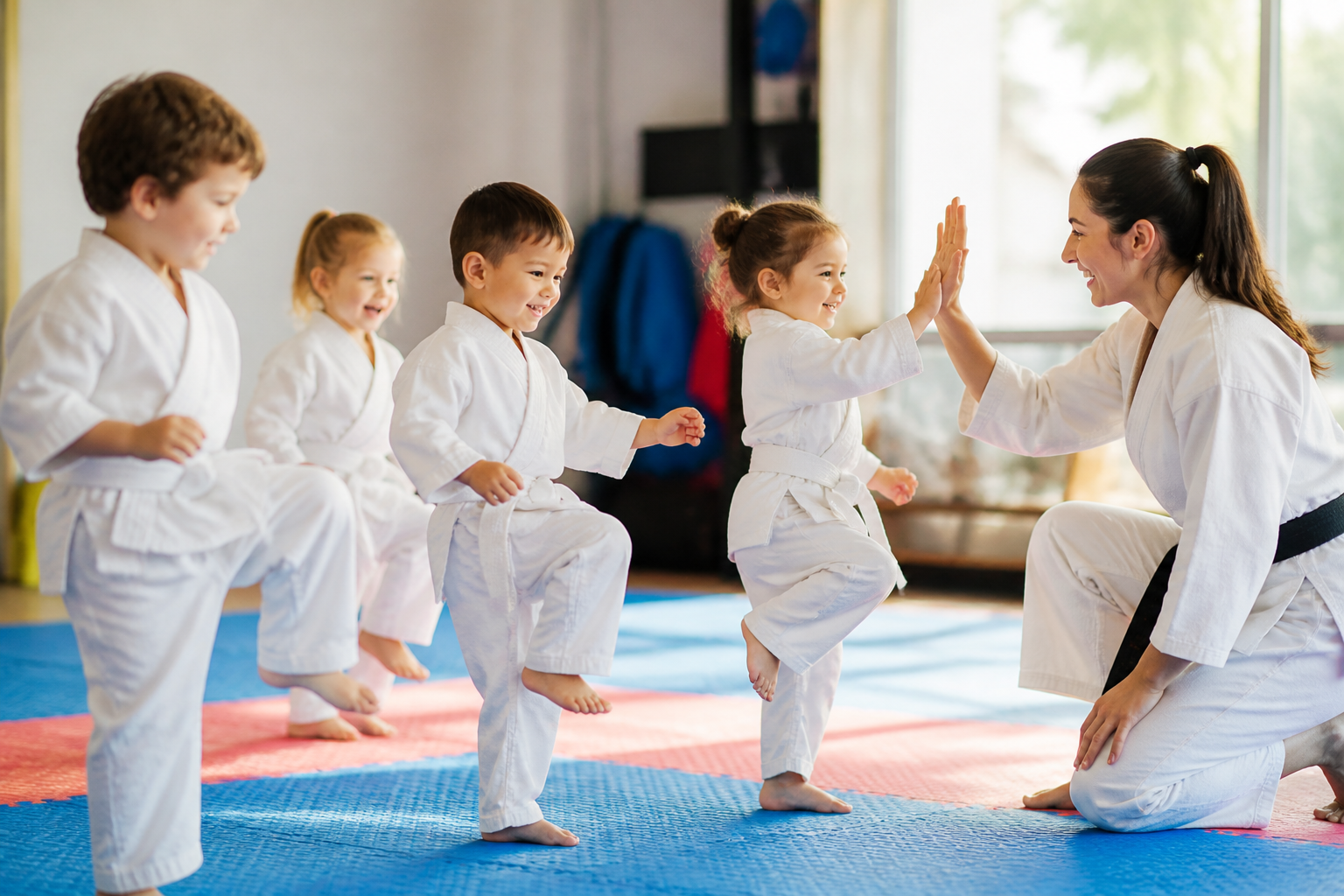
What are the main benefits of martial arts for kids ages 3 to 5?
Martial arts for kids ages 3 to 5 provides a foundation for physical coordination, emotional regulation, and social discipline. Through structured play and repetitive movements, preschoolers develop essential gross motor skills while learning to follow multi-step directions and interact respectfully with peers. These programs focus on "life skills" like focus and patience rather than combat or self-defense.
Starting martial arts early helps children manage high energy levels and prepares them for the classroom environment. By practicing balance, listening, and controlled movements, 3- to 5-year-olds build the confidence needed to tackle new challenges at home and in school.
Key points to consider:
- Physical Coordination: Classes improve balance, core strength, and bilateral integration through specialized drills.
- Focus and Listening: Students learn to maintain eye contact and respond to verbal cues immediately.
- Social Integration: Children practice taking turns, sharing space, and showing respect to instructors and classmates.
- Emotional Resilience: Early exposure to martial arts teaches kids how to handle frustration and try again after a mistake.
- School Readiness: The structured environment mimics a classroom setting, helping kids adapt to formal education.
How does martial arts help with preschooler physical development?
Martial arts helps preschoolers develop physical literacy by engaging multiple muscle groups and improving spatial awareness. Unlike many traditional sports that focus on a single skill, martial arts involves the entire body in asymmetrical movements, which strengthens the connection between the left and right sides of the brain. This is critical for children in the 3-to-5 age range as they move from toddlerhood into more complex physical activities.
At this age, the focus is on gross motor skills. Exercises such as hopping on one foot, crawling through obstacle courses, and executing basic kicks help develop the vestibular system. This system is responsible for balance and spatial orientation. When a child learns to stand on one leg to perform a slow kick, they are building core stability that will help them sit upright in a school chair and maintain focus later in life.
Furthermore, martial arts improves "proprioception," which is the sense of where one's body is in space. For a 4-year-old who might be prone to tripping or bumping into furniture, learning how to move with intent and control reduces accidental injuries and builds a sense of physical competence.
Can martial arts improve listening skills in 4-year-olds?
Martial arts improves listening skills by using a "call and response" system that requires immediate physical and verbal engagement. In a typical class, an instructor gives a command, and the student must perform a specific action, which creates a direct link between auditory processing and physical movement. This repetitive practice helps children filter out distractions and focus on the person speaking.
Listening in a martial arts context is often broken down into three levels: listening with the ears, listening with the eyes (maintaining eye contact), and listening with the heart (showing respect). For 4-year-olds, who are naturally easily distracted, these visual and physical cues provide a framework for what "paying attention" actually looks like. Instead of being told to "be quiet," they are given a task that requires their full attention to succeed.
The structured nature of the class also introduces the concept of "active waiting." Students often have to wait their turn to strike a pad or move through a line. This teaches impulse control, a key component of effective listening and social behavior.
How does martial arts build social confidence in young children?
Martial arts builds social confidence by providing a safe, predictable environment where children can master new skills and interact with peers under clear rules of engagement. For a 3- to 5-year-old, the "uniform" or "gi" acts as a social equalizer, making them feel like part of a team or community from their very first day. This sense of belonging is a powerful catalyst for confidence.
Social confidence is developed through several specific interactions:
- The Bow: Every class begins and ends with a bow, teaching children a physical way to show and receive respect.
- Partner Drills: Working with a partner to hold a pad or take turns teaches cooperation and empathy.
- Public Praise: Instructors often highlight a student's effort in front of the class, reinforcing positive behavior and giving the child a sense of pride.
By consistently overcoming small challenges—such as breaking a board for the first time or memorizing a basic sequence of movements—children learn that they are capable. This "can-do" attitude carries over into their interactions on the playground and in the classroom, reducing social anxiety.
What is the difference between preschool martial arts and older kids' classes?
Preschool martial arts classes differ from older kids' programs by focusing on developmental milestones and play-based learning rather than technical precision or competitive sparring. For children ages 3 to 5, the curriculum is designed to accommodate shorter attention spans and the need for frequent physical transitions. The goal is to make fitness and discipline fun so that the child develops a lifelong positive association with physical activity.
Step 1: Focus on Fundamental Movements
In a preschool class, techniques are simplified. Instead of complex forms (katas), students learn basic stances and movements that resemble "animal shapes" to make the learning process relatable and engaging.
Step 2: Gamified Discipline
Instructors use games to teach discipline. For example, a "freeze" game might be used to teach a child how to stand perfectly still in a "ready stance," turning a difficult task of self-control into a fun challenge.
Step 3: Shorter Duration and High Energy
Classes for 3-5 year olds are usually shorter (30 to 45 minutes) and move at a faster pace to keep students engaged. The transitions between activities are quick to prevent boredom and minimize behavioral issues.
Step 4: Emphasis on Character over Combat
While older kids might learn self-defense applications, the preschool curriculum emphasizes "mat chats" about honesty, kindness, and following directions at home. The "martial" aspect is a tool for character development rather than a focus on fighting.
Is martial arts safe for children under 5?
Martial arts is exceptionally safe for children under 5 because the curriculum excludes high-impact contact and focuses on controlled, individual movements. In a reputable program, preschoolers do not spar with one another; instead, they strike soft pads or targets held by an instructor. This eliminates the risk of injury from physical confrontation while still allowing the child to practice power and technique.
Safety is also maintained through strict instructor-to-student ratios. Because 3- and 4-year-olds require more supervision, classes are typically smaller or have multiple assistants on the floor to ensure every child is following instructions and moving safely. The mats used in martial arts studios are specifically designed to absorb impact, providing a much safer environment for jumping and tumbling than a typical hardwood floor or playground surface.
Common Mistakes to Avoid
- Pushing for technical perfection: At age 3 or 4, a child's coordination is still developing. Focus on their effort and participation rather than whether their kick is "perfect."
- Choosing a "fight-centric" school: Avoid schools that put 5-year-olds in headgear and gloves to spar. Look for programs that prioritize character and motor skills.
- Comparing your child to others: Every child hits developmental milestones at different times. Martial arts is an individual journey; celebrate your child's personal progress.
- Treating it as a babysitting service: Parental engagement—even if just watching from the sidelines—shows the child that their hard work is valued.
- Stopping too soon: Progress in martial arts is cumulative. Many parents quit if their child has one "off" day, but the real benefits come from consistency over several months.
How Austin HQ Supports Early Childhood Development
At Austin HQ, we recognize that the needs of a 3-year-old are vastly different from those of an 8-year-old. Our "Little Heroes" and preschool programs are built around the specific cognitive and physical stages of early childhood. We don't just teach kicks and punches; we use martial arts as a vehicle to teach the "Ready-for-School" skills that parents value most.
Our instructors are trained in early childhood movement, ensuring that every drill is age-appropriate and safe. We maintain a high instructor-to-student ratio so that every child receives the encouragement they need to succeed. By integrating dance-like fluidity and martial arts discipline, we provide a well-rounded physical education that keeps kids excited to come back to the studio every week. Our focus is on building a community where your child feels safe to try, fail, and eventually succeed.
Frequently Asked Questions
What is the best age to start martial arts?
Most experts agree that age 3 or 4 is the ideal time to start, as children have developed the basic motor skills and verbal understanding necessary to follow simple instructions. At this age, the focus is on "pre-martial arts" skills that build a foundation for later years.
Will martial arts make my child more aggressive?
No, martial arts actually does the opposite by providing a healthy outlet for energy and teaching self-control. Students are taught from day one that the skills they learn are only for the studio and that hitting or kicking outside of class is not allowed.
How often should a 4-year-old attend class?
For preschoolers, attending class twice a week is usually the "sweet spot" for retention and progress. This frequency allows the child to remember what they learned in the previous session without feeling overwhelmed or burnt out.
Do I need to buy a lot of equipment right away?
Generally, no. Most programs for kids ages 3 to 5 only require a basic uniform. Specialized equipment like sparring gear is typically reserved for older, more advanced students who have demonstrated the necessary discipline.
What if my child is very shy?
Martial arts is an excellent choice for shy children because it allows them to participate in a group setting without the pressure of a team-ball sport. They can progress at their own pace, and the consistent routine helps them feel secure enough to eventually step out of their comfort zone.
Can kids with ADHD benefit from martial arts?
Yes, the structured environment and clear, short-term goals of martial arts are highly beneficial for children with ADHD. The emphasis on focus, repetitive movement, and immediate feedback helps them practice self-regulation in a supportive environment.
Ready to see the benefits firsthand?
The best way to understand how martial arts can help your child is to experience a class. Whether you are looking to improve your child's focus, burn off extra energy, or build their confidence before they start kindergarten, Austin HQ is here to help. Contact us today to learn more about our introductory programs for ages 3 to 5 and join our community of families dedicated to healthy, happy development.
